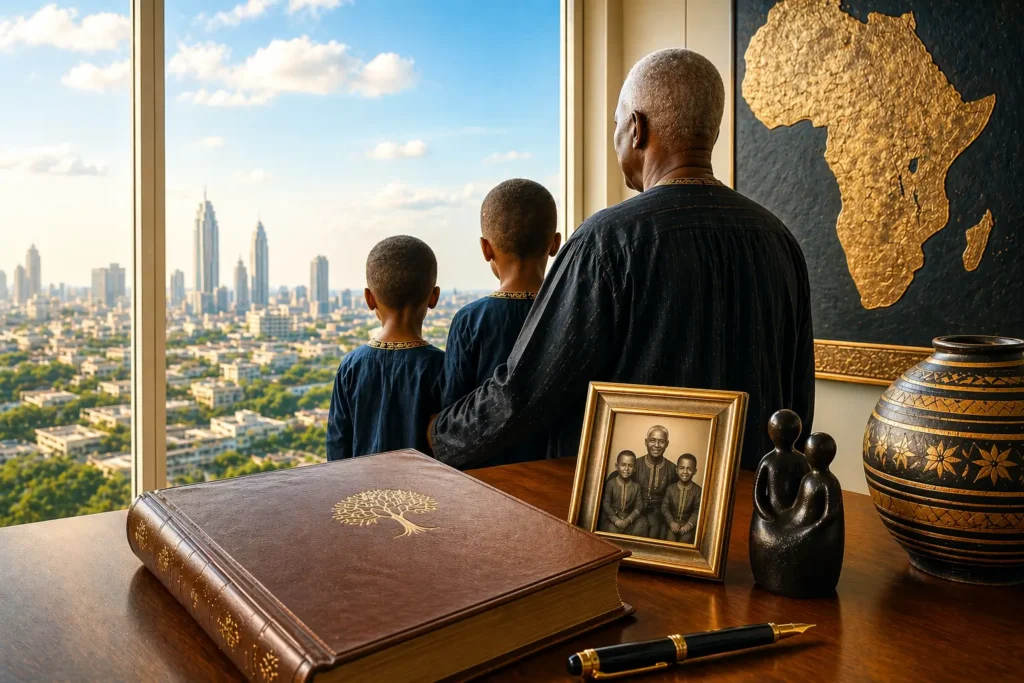
My grandfather never had a financial planner. He never opened a brokerage account, never attended a wealth seminar, and I don’t think he ever even heard the word “portfolio”. And yet, when he died, he left behind something that no spreadsheet could fully capture: a family that knew who they were, what they stood for, and what they owed each other.
This is the paradox at the heart of legacy planning in African families. A blueprint has always existed. But it seems like we’ve stopped reading it.
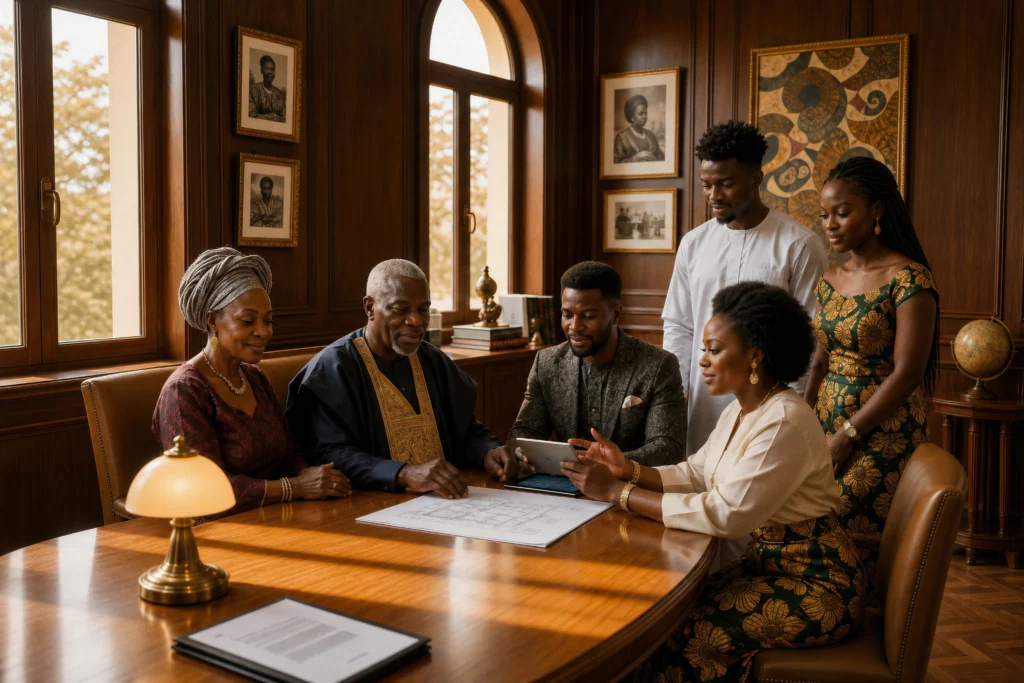
Across the African continent and its diaspora, traditional societies operated on a model of intergenerational wealth that was simultaneously communal and strategic. The extended family itself was the infrastructure. Elders were not housed in retirement homes but lived with the larger family, and so were unavoidably embedded at the center of decision-making.
Land was held by families not individuals, held in trust for those not yet born. These were not sentimental arrangements. We see that the African traditional system has always been intentionally designed to cater to the generations to come. The African system has always been about legacy.
The problem is that somewhere along the way, we adopted a western framework for legacy planning that was never designed with African families in mind. That model is built around the individual: individual assets, individual tax liabilities, individual retirement accounts. It assumes a nuclear family structure. It comes at the cost of privacy between relatives. It treats wealth as something to be accumulated quietly and distributed according to a will.
But African family structures are not nuclear. They are networked. The obligations run sideways as much as they run downward. A first-generation professional in Lagos or London is not just planning for her children. She is, whether she acknowledges it or not, a node in a much larger system of interdependence.
The question is not whether you will participate in that system. You already are. The question is whether you will participate intentionally.
Legacy planning for African families must start with a different conversation, one most financial advisors don’t have. Before the question of assets comes the question of values. What does this family stand for? What is the behaviour we want modeled, not just wealth? Who are the decision-makers in the next generation, and how are we developing them? What happens when there is conflict, and who mediates it?
None of these questions appear on a standard estate planning checklist. But they are the difference between a family that builds across generations and one that fragments the moment the patriarch or matriarch is gone.
The African family blueprint for legacy is not about nostalgia. It is not about pretending that the complexity of modern financial life does not exist. It is about recognizing that the old frameworks had structural wisdom embedded in them, wisdom about accountability, about collective memory, about the role of our elders, and about what it means to belong to something larger than yourself.
The families that will build lasting legacies in this generation are the ones willing to do two things at once: engage the tools of modern financial planning seriously and refuse to let those tools erase the relational architecture that made African families resilient long before financial advisors existed.
My grandfather probably did not call it legacy planning. But he was living it every single day. You can too.
By Chiziterem Ogbonna, Private Client Advisor, The Legacy Haus